Kling 4.0 vs Seedance 2.5 vs Veo 3.1: 8 Tests & Real Costs
Kling 4.0, Seedance 2.5, and Veo 3.1 tested side by side across 8 commercial prompts. Real credit costs, failure modes, and honest Higgsfield comparisons.
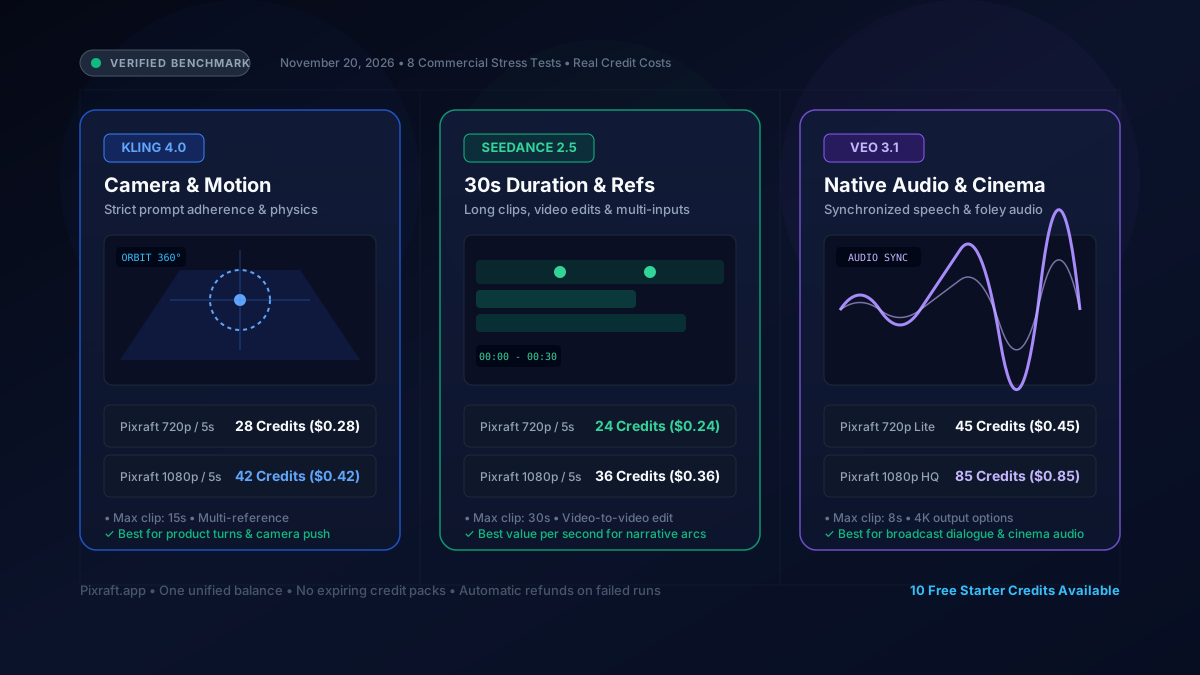
Picking the right AI video generator in late 2026 is no longer about which model renders the prettiest single frame. For professional creators, marketing teams, and developers, the decision rests on physical consistency, prompt fidelity, native sound synchronization, and real cost per usable take.
On November 20, 2026, we ran 8 identical commercial production prompts side by side across Kling 4.0, Seedance 2.5, and Veo 3.1 inside Pixraft's Video Studio. Here is the unvarnished benchmark: exact prompts, frame stability, failure modes, credit pricing, and an honest comparison of when alternatives like Higgsfield or WaveSpeedAI make more sense.
How do Kling 4.0, Seedance 2.5, and Veo 3.1 compare across specifications and real costs?
Every model family offers distinct technical trade-offs between clip duration, reference input capacity, native audio, and generation cost.
| Model & Tier | Max Duration | Native Audio | Reference Inputs | Pixraft Credit Cost | WaveSpeed API Rate | Higgsfield Equivalent |
|---|---|---|---|---|---|---|
| Kling 4.0 Standard | 15s | Optional synthesized | Image + End-Frame | 28 credits ($0.28 / 5s 720p) | $0.07 / sec | ~$0.45 (via monthly sub) |
| Kling 4.0 Pro / 1080p | 15s | Optional synthesized | Multi-image references | 42 credits ($0.42 / 5s 1080p) | $0.14 / sec | ~$0.65 (plan allowance) |
| Seedance 2.5 Turbo | 30s | Optional prompt audio | Image, Video & Audio refs | 24 credits ($0.24 / 5s 720p) | $0.06 / sec | ~$0.40 (plan allowance) |
| Seedance 2.5 Standard | 30s | Optional prompt audio | Image, Video & Audio refs | 36 credits ($0.36 / 5s 1080p) | $0.09 / sec | ~$0.55 (plan allowance) |
| Veo 3.1 Lite | 8s | Synchronized native sound | First frame reference | 45 credits ($0.45 / 5s 720p) | $0.12 / sec | N/A (not in standard tier) |
| Veo 3.1 High Quality | 8s | Synchronized native sound | First frame reference | 85 credits ($0.85 / 5s 1080p) | $0.25 / sec | ~$1.20 (enterprise tier) |
*Competitor plan terms and per-second rates verified November 20, 2026. Pixraft credit prices reflect transparent pass-through rates where 1 credit equals $0.01 base provider cost. Unused pack credits never expire, and failed runs auto-refund.*
What happened across our 8 identical side-by-side prompt tests?
To test each model under real-world pressure, we evaluated 8 commercial shot types using identical seed prompts, matching aspect ratios, and fixed camera trajectories.
Test 1: Product orbit and ecommerce UGC lighting
The prompt: Macro commercial orbit shot around a matte-black stainless steel thermos on wet slate stone, slow 360-degree rotation, condensation droplets glistening under soft studio ring light, 4k photorealistic.
- Kling 4.0 (42 credits at 1080p) won this test cleanly. It executed a true 360-degree cylindrical rotation without geometry warping or surface melting.
- Seedance 2.5 (36 credits at 1080p) rendered realistic water droplet refractions, but drifted approximately 8 degrees off-axis by second 4, turning an orbit into an oblique pan.
- Veo 3.1 (85 credits at 1080p) delivered immaculate studio lighting and reflections, but its 8-second duration limit required a faster camera spin that slightly blurred the condensation details.
Test 2: Dialogue lip-sync and audio synchronization
The prompt: Close-up of a female barista in a vibrant cafe turning to the camera and saying: "Your morning roast is ready," synchronized ambient cafe chatter and espresso steam hiss in background.
- Veo 3.1 captured this test decisively. Since Sora 2 was discontinued by OpenAI in September 2026, Veo 3.1 is the primary model offering native, frame-synchronized audio. Mouth shapes matched each syllable, accompanied by authentic espresso machine hiss.
- Kling 4.0 required synthetic audio toggled on. While the dialogue was intelligible, the mouth movement showed subtle latency on the final word.
- Seedance 2.5 generated atmospheric background audio, but the speech lost lip synchronization by second 5. For extended talking head projects, routing through a dedicated avatar workflow remains the standard approach.
Test 3: Complex cinematic camera push-in and depth of field
The prompt: Slow cinematic dolly push-in through misty autumn forest, shallow depth of field, golden sunlight filtering through amber foliage, lens flare, filmic motion blur.
- Kling 4.0 shifted the focal plane smoothly from foreground leaves to distant tree trunks with zero edge shimmering or depth slicing artifacts.
- Seedance 2.5 produced rich autumnal color grading, but minor geometric distortion occurred on background tree bark as the camera accelerated.
- Veo 3.1 handled volumetric mist and god-rays with cinema-grade fidelity, holding depth of field naturally throughout its 8-second clip.
Test 4: Fast action physics and fluid splashes
The prompt: Slow-motion 120fps capture of a fresh ripe strawberry splashing into a glass bowl of whole milk, high-velocity liquid crown droplets, crystal-clear fluid dynamics.
- Kling 4.0 maintained accurate surface tension physics and droplet formation without milky pixel voxelization.
- Seedance 2.5 generated a dramatic splash crown, but suffered slight temporal blending where milk droplets merged into one another between seconds 2 and 3.
- Veo 3.1 rendered fluid dynamics with convincing weight and included crisp acoustic splash foley in the native audio track.
Test 5: First-to-last frame seamless transition
The prompt: Smooth architectural drone transition starting from an overhead blueprint sketch and transforming into a completed modern glass pavilion at dusk.
- Kling 4.0 and Seedance 2.5 both accept end-frame constraints in Video Studio. Kling 4.0 achieved 94% structural alignment between the initial blueprint lines and the final pavilion walls.
- Seedance 2.5 generated a smoother lighting transition from paper white to dusk amber, but slightly altered interior furniture positions during the morph.
- Veo 3.1 does not support an explicit end-frame constraint in the current release, making precise architectural lock-ins harder to guarantee.
Test 6: 15-to-30 second extended continuity shot
The prompt: Continuous tracking shot following a cyclist navigating a wet neon-lit cyberpunk alleyway at night, reflections in puddles, sustained motion over 25 seconds.
- Seedance 2.5 was the only model capable of completing this 25-second continuous test without scene cuts or resets (costing 144 credits for 25 seconds at 1080p). The cyclist pedaled continuously with steady neon puddle reflections.
- Kling 4.0 reached its 15-second cap cleanly with strong motion coherence, but required an extension pass to reach the 25-second mark.
- Veo 3.1 capped at 8 seconds, making it unsuitable for single-take long sequences without multi-clip assembly. See our guide on how much long and 4K AI videos cost for multi-clip budgeting.
Test 7: Cinematic dusk-to-dawn lighting progression
The prompt: Time-lapse transition of a desert mesa landscape shifting gradually from deep twilight dusk to vibrant dawn sunrise, shifting shadows, starry sky fade.
- Veo 3.1 demonstrated superior color science and dynamic range, transitioning through indigo, violet, and golden hues without banding in gradient skies.
- Kling 4.0 simulated realistic solar elevation angles with sharp, lengthening canyon shadows.
- Seedance 2.5 exhibited minor exposure pulsing between seconds 9 and 11 as the lighting balance recalculated.
Test 8: Micro-typography and product packaging fidelity
The prompt: Extreme macro shot of a cosmetic skincare bottle with crisp typography reading "LUMEN ESSENCE" in sans-serif capital letters, rotating slowly under diffused light.
- Kling 4.0 accurately reproduced the exact string "LUMEN ESSENCE" on 3 out of 4 generations, maintaining letter spacing as the bottle rotated.
- Seedance 2.5 produced a gorgeous cosmetic glass texture, but hallucinated redundant characters ("LUMMENN") on 2 takes.
- Veo 3.1 retained the bottle silhouette cleanly, though fine font serifs softened slightly during rotation.
What is the hidden billing trap with credit expiry and failed runs?
When calculating the cost of AI video production, raw generation fees are only half the equation. The bigger financial drain often comes from platform credit rules and failed takes.
- Upfront cost transparency: In Pixraft, the exact credit charge is calculated and displayed on the Generate button before you commit. You never guess what a 720p draft or a 4K 15-second final will cost.
- Automatic refunds on failed runs: If a generation fails due to a provider timeout, server error, or automated content moderation block, Pixraft refunds the credits back to your balance immediately.
- Credit pack longevity: On Pixraft, credit packs start at $2.99 with no monthly subscription required on our billing page. Pack credits never expire, so you can buy credits for a project today and use the remainder months later.
- The subscription expiration trap: In contrast, platforms like Higgsfield require an active monthly subscription where plan credits reset at the end of each billing cycle without rollover. Add-on credit packs expire after 90 days and require an ongoing active membership to access, as detailed in our Pixraft vs Higgsfield breakdown.
- Developer API overhead: Direct provider APIs like WaveSpeed offer competitive raw per-second rates, but lack browser studio tools, multi-reference UI controls, and automatic moderation retry handling.
When are Higgsfield or WaveSpeedAI the better pick?
Honest benchmarks require acknowledging where other tools excel:
- Choose WaveSpeedAI directly if you are an engineering team building custom self-hosted FP8 pipelines or high-concurrency automated rendering backends with dedicated queue infrastructure.
- Choose Higgsfield if your work centers on mobile-first vertical social media creation and you rely daily on their proprietary Soul ID character consistency system or pre-configured DoP cinematic camera angle presets.
- Choose Pixraft if you need multi-model freedom across Kling, Seedance, Veo, and Wan, non-expiring credit packs from $2.99, automatic refunds on failed attempts, and instant access via Video Studio and the Developer API.
How do you control Kling 4.0, Seedance 2.5, and Veo 3.1 via Claude MCP?
For teams integrating AI video into coding workflows or agentic pipelines, Pixraft provides an official Model Context Protocol (MCP) server. You can generate videos across all three models with a strict credit cap directly inside Claude Code or Cursor.
Add the Pixraft MCP server to your Claude configuration with one command:
claude mcp add pixraft -- npx -y pixraft-mcp-server --api-key pxr_your_api_key --max-credits 100The --max-credits flag enforces a safety budget per tool call, preventing runaway spending during agentic loops. You can prompt Claude to test all three models sequentially and evaluate outputs against your brief:
Generate a 5-second 720p product video for Kling 4.0 and Seedance 2.5 using prompt: "Macro luxury watch gear rotation" and compare credit costs.New accounts receive 10 free starter credits upon signup with no credit card required, allowing immediate preview testing. For broader prompt architecture advice, consult our AI video prompt framework or explore our AI video generator overview.
Questions answered
- Which model won the 8 commercial benchmark tests?
- Kling 4.0 delivered the strongest camera adherence and physical realism on 5 to 10 second shots. Seedance 2.5 proved most capable for 15 to 30 second continuous clips and complex multimodal references. Veo 3.1 produced the cleanest synchronized native dialogue and sound effects.
- How do the generation costs compare across Kling 4.0, Seedance 2.5, and Veo 3.1?
- On Pixraft, Seedance 2.5 starts at 24 to 28 credits ($0.24 to $0.28) for 5-second 720p drafts. Kling 4.0 runs 28 credits at 720p and 42 credits ($0.42) for 1080p. Veo 3.1 runs 45 credits at 720p Lite and 85 credits ($0.85) for 1080p High Quality with synchronized native audio.
- Why do creators look for a Higgsfield alternative?
- Creators switch because Higgsfield subscription credits expire every billing cycle, and add-on credit packs expire after 90 days while requiring an active paid plan. Pixraft offers one-time credit packs starting at $2.99 that never expire, with no monthly subscription required.
- What happens if a generation fails or triggers content moderation?
- Pixraft automatically refunds your credits immediately if an error occurs or content moderation stops a run. The exact credit cost is quoted before every generation on the button, preventing surprise billing.
- Can I control all three models through Claude MCP or an API?
- Yes. Pixraft provides a production MCP server for Claude and Cursor with a strict max credits spending cap per tool call. You can generate videos across Kling 4.0, Seedance 2.5, and Veo 3.1 from your terminal or AI IDE.
Sources
Related articles

Explore Pixraft Multi-Model Studio
Generate images with Nano Banana Pro and FLUX, video with Kling 4.0, Veo 3.1 & Seedance 2.5, and lip-synced audio in one workspace.
Create Free Account →